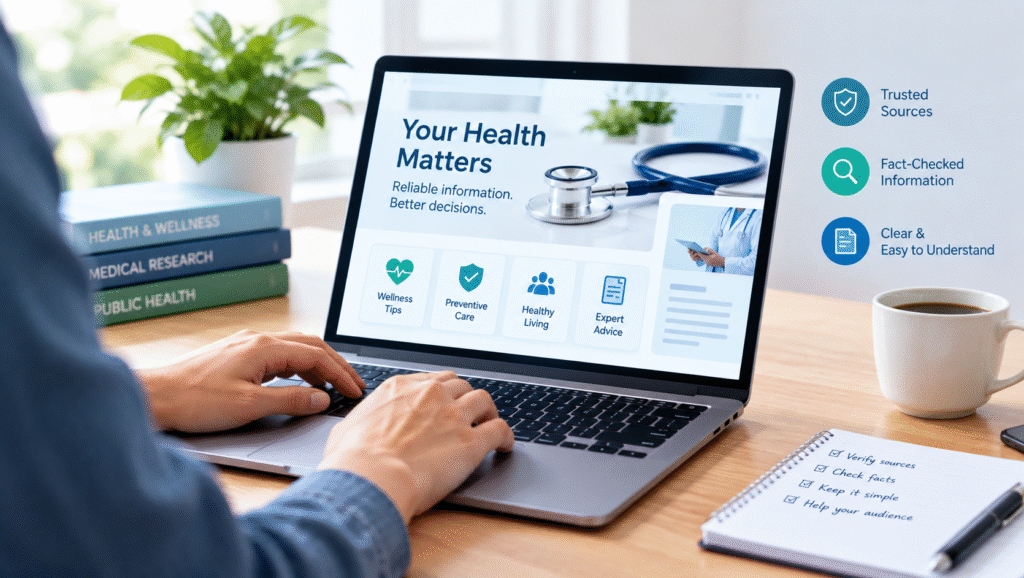
Health information can influence everyday choices, from what people eat to when they seek professional care. That makes publishing about health more demanding than writing about many other subjects: an engaging article must also be accurate, clear about its limits, and useful to readers with different levels of knowledge. Whether you run a health website, work in communications, or are planning a specialist article, a thoughtful process helps build trust and reach the right audience.
Good health publishing is not just a matter of putting words on a page. It involves choosing a worthwhile question, researching it carefully, explaining it responsibly, and deciding where readers are likely to find it. Here are practical steps for doing that well.
Start With a Specific Reader Need
Broad subjects such as fitness, nutrition, or mental health can be difficult to cover meaningfully in one article. Begin instead with a question a reader might genuinely ask: How can someone prepare for a first appointment with a dietitian? What should a traveler consider when managing medication across time zones? How can a beginner build a realistic walking routine?
A focused question helps you set boundaries. It also makes it easier to distinguish general education from personal medical advice. A useful article can explain common considerations, suggest questions to raise with a qualified professional, and point out when individual circumstances matter. It should not diagnose readers or promise a particular outcome.
Research Before You Draft
Health claims need more than a confident tone. Check the original source of important figures and recommendations, and note when the material was published or updated. Government health agencies, established medical institutions, and peer-reviewed research can provide a strong starting point, but the source should still be relevant to the question being discussed.
- Trace claims to their source: If an article cites a study, look at the study itself where possible, rather than relying only on another article’s summary.
- Check the context: A finding from a small or limited study may not apply to everyone. Explain important limitations instead of presenting early research as settled fact.
- Separate evidence from opinion: Make clear when a recommendation comes from a recognized guideline, a study, or an individual perspective.
- Review time-sensitive details: Advice, statistics, and public-health guidance can change. Revisit older content and update it when needed.
When a subject is complex or potentially high-risk, ask an appropriately qualified professional to review the draft. A review does not remove the writer’s responsibility to check facts, but it can identify ambiguity or missing context before publication.
Write for Understanding, Not Just Expertise
Readers should not need specialist training to follow the main point. Define unfamiliar terms the first time they appear, use short sections, and make each heading describe what the next section explains. Practical examples can help, provided they do not imply that one person’s experience represents everyone’s.
Be precise with language. Words such as “may,” “can,” and “is associated with” convey uncertainty more accurately than a definite promise when evidence is mixed. Avoid alarmist headlines, miracle-cure framing, or claims that a single habit will prevent illness. A brief note explaining that an article is educational and cannot replace personalized medical advice can set a helpful boundary.
Choose a Suitable Place to Publish
Even a carefully researched article is less useful if it appears in front of an audience with little interest in the subject. Before approaching a publication, read its existing articles, check its audience and editorial focus, and consider whether your proposed topic fits. A relevant placement is more meaningful than a large but poorly matched audience.
For organizations looking at health publishers, health guest-posting websites can help with discovering publications across areas such as healthcare, fitness, nutrition, mental health, and wellness. Treat any directory as a starting point, not a substitute for editorial judgment. Review each publisher’s readership, standards, and recent content before deciding whether to pitch.
When writing for another site, adapt the article to that publication rather than sending the same generic pitch everywhere. Offer a clear angle, explain why it suits the readers, and provide a concise outline. Respect the publisher’s rules on links and disclosures; an article should offer value even if a reader never clicks away.
Bring in Specialist Support When Needed
Small teams may not have every skill in-house. A project could require a health writer, editor, designer, translator, or developer, depending on its scope. A freelance marketplace such as Osdire lets buyers find services across categories including writing and translation, design, programming, and marketing. As with any hiring process, define the task, deadlines, qualifications, and revision expectations before work begins. For health-related assignments, ask about relevant experience and plan for appropriate expert review.
Clear briefs make collaboration smoother. Include the intended audience, the article’s purpose, the sources to consult, the required format, and any claims that must be avoided. Agree on who checks factual accuracy and who gives final approval. If several people contribute, assign one editor to keep the voice consistent and resolve conflicting feedback.
Make Quality an Ongoing Practice
Publishing is not the last step. Track whether readers engage with the material, note recurring questions, and use that feedback to improve future articles. Review important pages periodically, especially when they discuss treatment, public-health recommendations, or other fast-changing topics. Correct errors transparently and date substantive updates so readers can understand when information was checked.
The strongest health content balances usefulness with humility. It answers a real question, shows readers how conclusions were reached, and acknowledges where general information ends. With careful research, accessible writing, suitable editorial partners, and regular review, publishers can help people make better-informed decisions without overstating what an article can do.